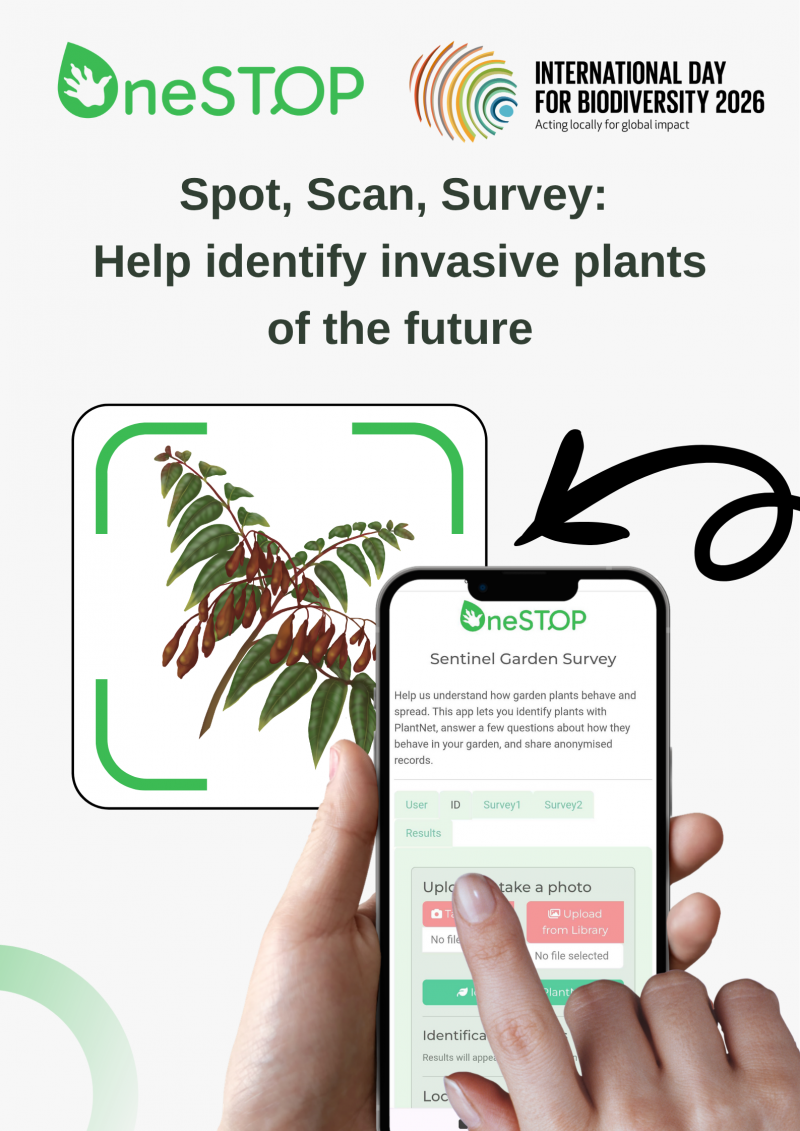
Spot, Scan, Survey: Help identify invasive plants of the future
This year’s International Day for Biological Diversity, celebrated on 22 May, carries the theme “Act locally for global impact.” It highlights how local actions can contribute to addressing broader environmental challenges. One example is citizen science, where individual observations can provide valuable data for biodiversity monitoring, including the early detection of invasive alien species (IAS).
To encourage citizen science contributions, OneSTOP is organising a series of activities people can take part in from their own gardens. We are launching a new web app to expand the successful PlantAlert project across our Living Lab countries. We invite gardeners to turn their private spaces into “sentinel gardens” for IAS monitoring by reporting any garden plants spreading out of control. Ornamental plants spreading from gardens are one of the main sources of invasive plants in Europe. By identifying species causing problems in gardens now, we can identify the potential invasives of the future and help to prevent them from spreading into the countryside.
How are we surveying plants
In order to facilitate the reporting on garden plants, OneSTOP has developed a web app. It lets you identify plants with PlantNet, submit your observations to iNaturalist, and answer a few questions about how these plants behave in your garden. We would like to hear about any ornamental plants spreading to an extent that you have to control them to prevent them overgrowing other plants or parts of your garden where you don’t want them.
By working with existing applications and citizen science platforms, OneSTOP ensures all records contribute to global efforts to reduce negative impacts from invasive plants while also providing evidence to gardeners and the ornamental plant trade on which species may become problematic in gardens and should perhaps be sold with warnings or not at all.
The app will officially be launched and promoted by our Belgium Living Lab partner Tim Adriaens (Research Institute for Nature and Forest) at an upcoming GuardIAS Workshop on Invasive Freshwater Plant Management. The event will be held in Ghent, Belgium, where Tim will invite local stakeholders to test the app and provide feedback. You can test the web app yourself here. Apps for Android and Apple are under development.
What is a sentinel garden
Private gardens, particularly in urban areas, play an important role in IAS introductions, both through cultivated plants spreading into new environments and the unintentional movement of weeds, diseases, and invertebrates via soil and plant transport. Thus, engaging gardeners in reporting species can deliver critical information and reduce detection delays.
In that sense, a ‘sentinel garden’ acts as an early warning site for biodiversity monitoring. By observing which species appear where and how they behave, gardeners can help detect IAS at an early stage. In this way, everyday garden spaces become valuable sources of information, supporting researchers with observations from locations that are otherwise difficult to monitor.
How else can you get involved
We are also developing some citizen science activities to help look for potentially invasive invertebrates such as slugs and flatworms and hope to launch these soon. In the meantime, you can upload observations of any unusual species you find in your gardens to iNaturalist.